



Sunday, Aug. 16 — 6:39 PM : A previous version of this post stated that Community Passageways received $44M in revenue in 2024. This was incorrect. CP received over $44m in direct revenue during the five year cycle that ended in 2024, per their 990. They’ve received over $32 million since 2021. The 990 for 2025 and 2026 aren’t posted and/or completed yet. We regret the error. - KTH
While Community Passageways pocketed tens of millions to stop school violence, its staff were busy embezzling, running guns, and abandoning their security posts for offsite conferences. Teens died on their watch.
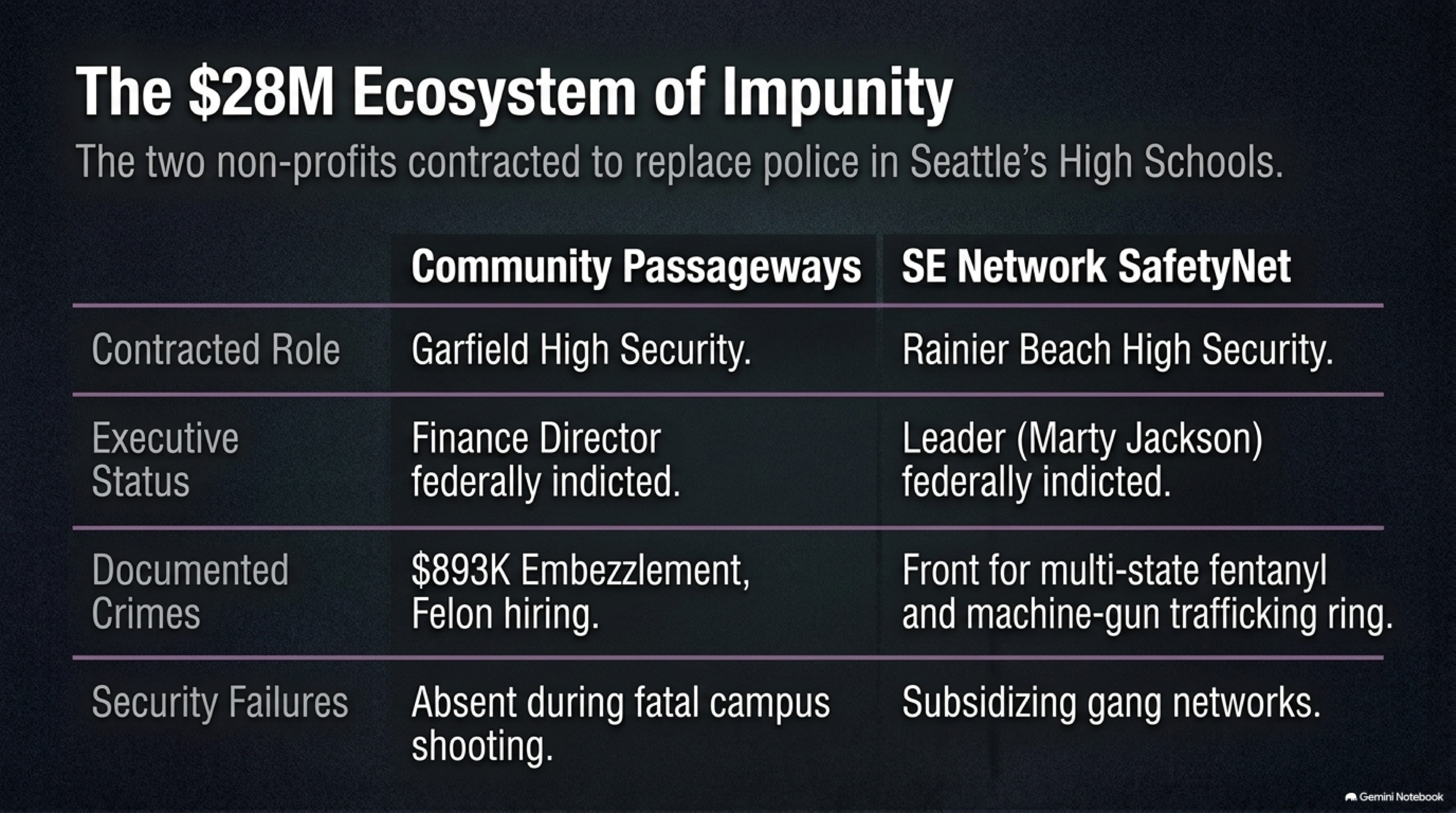
The non-profit’s finance director looted nearly nine hundred thousand dollars of public cash to fund casino sprees and shopping trips at Nordstrom.
Meanwhile, the organization’s celebrated violence interrupters built a parallel rap sheet featuring armed home burglaries, active domestic violence orders, and federal gun-running convictions.
Subcontracts went straight to registered sex offenders with forged credentials.
Contracted to protect Garfield High School and achieve zero campus shootings, the entire safety team blew off their posts June 6, 2024 to attend a violence prevention conference at Lumen Field.
Left completely unguarded, the campus became a murder scene where seventeen-year-old Amarr Murphy-Paine was gunned down during lunch.
Instead of shuttering the operation, Seattle Public Schools extended the contract while CEO Dominique Davis promised everyone would show up next time.
SEATTLE — Rainier Beach High School replaced police with a non-profit run by an indicted drug kingpin whose deadly fentanyl killed four members of the Lummi Nation. You wouldn’t think it could get much worse than that.
But this is the Seattle Public Schools Cinematic Universe of Criminality, and at Garfield High School, cops were replaced by Community Passageways (CP), a non-profit paid to stop school violence.
Instead, CP’s staff were busy embezzling, committing domestic violence, running guns, and abandoning their posts ahead of incidents of on campus gun violence.
Two teenagers died on CP’s watch.
And yet year-after-year, SPS extends their contract, refusing to return police to campus.
When Seattle’s interim police chief stood before reporters and praised the county’s community-led “violence interrupters,” last week, the remarks followed a familiar script.
For five years, King County and Seattle Public Schools have bet millions on the premise that unvetted, non-police contractors can secure high school hallways.
The strategy has coincided with the violent deaths of eight unarmed Black teenagers on or adjacent to Seattle school grounds since 2021.
Before the district removed sworn School Resource Officers that year, more than a quarter-century had passed without a fatal campus shooting.
In 2022, Community Passageways hired Khalid Adams as a violence interrupter, just twelve months after Adams was convicted on felony firearms charges. While employed and drawing a county-backed paycheck, Adams executed an armed home invasion at his ex-girlfriend’s apartment, holding her new partner at gunpoint.
Adams was shot during the burglary by an 18-year-old who was simultaneously enrolled in Community Passageways’ own youth diversion program. Adams was subsequently jailed on first-degree assault and burglary charges.
Community Passageways: Under the Cash Spigot

No organization capitalized on this shift more aggressively than Community Passageways.
Founded in 2016 by Dominique Davis, the non-profit positioned itself as the premier alternative to juvenile detention and traditional campus security.
By 2024, the group was hauling in over $44 million in revenue this cycle, including over $32 million in direct public funding since 2021, according to its Form 990 filings, anchoring a taxpayer-funded
