

Five Ways to Confront Predators in Public Schools: Settlement Presents Lake Stevens Superintendent with Path to Leadership in Fight Against Systemic Abuse
Earlier this week, Seattle’s new superintendent pledged to radically confront the manner in which SPS deals with misconduct cases, LSSD, at a crossroads, should ride with Seattle.

“We’re trying to really look at every single person that’s under investigation. Some people are still on leave for two years. Like, where’s the action? Either find something or don’t, you’ve got to move forward.”
- Ben Shuldiner, Seattle Public Schools Superintendent, on his frustration with investigations into educator misconduct.

LAKE STEVENS — The state’s education labor leaders and administrative risk management lawyers must’ve fallen off their collective chairs in shock last week when new Seattle Public Schools (SPS) Superintendent Ben Shuldiner pledged to radically alter the district’s handling of sexual misconduct cases, aiming to - among other things - eliminate administrative hoops that allow predators to secure payouts and avoid investigations.
This refreshing and much-needed public pivot by the leader of the state’s largest district signals a leveraging opportunity for the Lake Stevens School District - an opportunity to augment the impact of its own upcoming mandatory changes in sexual misconduct policy and education by joining forces with SPS in demonstrating commitment and thought leadership in an area that’s been severely lacking in both for decades.
By aligning with parallel reform efforts in Seattle, Lake Stevens has the chance to transform its much-discussed (and recently ended) 30-year-history of failures in confronting predatory staff… into a model for state-wide student safety.
Because of the tenants of a recent settlement, new policy adoption is a path LSSD is embarking on already. More on that in a second.

In Seattle, the change is coming because new leader arrived.
It took the new Superintendent just 60 days to recognize what he described as a systemic failure to put the safety of students first.
Shuldiner, arriving from Lansing, MI with an outsider’s perspective, admitted that it became clear to him that SPS lacks solid “systems and structures” to handle misconduct investigations in an effective, timely manner that protects children first and foremost.
“If you came up to my office, you would actually see stacks of data around investigations that have happened over the last couple of years and me really pushing to say, ‘Where are we with this? What’s going on?’” Shuldiner said in a recent interview with KUOW.
For instance, Shuldiner admitted he was at first stunned by the amount of staff lingering on paid leave during multi year probes. He told the district’s human resources department to pick up the pace on backlogged investigations.
“We’re trying to really look at every single person that’s under investigation. Some people are still on leave for two years,” Shuldiner said. “Like, where’s the action? Either find something or don’t, you’ve got to move forward. And I think that’s indicative of what (the public sees) — a slowness, an inaction, maybe an obfuscation.”
As part of a multi-million dollar settlement with a former student, the Lake Stevens School District (LSSD) is now legally committed to its own action: increasing its training for school staff and district-level administrators regarding sexual grooming and mandatory reporting.

The settlement followed years of J425 reporting into the misconduct of former teacher Mark Hein, whose actions were initially minimized by the district as “boundary invasions” rather than the arrest-worthy sex crimes identified by law enforcement.
In the end, the district agreed to monetary payment and negotiated policy implementation to confront the problem of predation.
In the opinion of J425, LSSD should take this once-in-a-generation opportunity (underscored by the fact that Lake Stevens’ Superintendent Dr. Mary Templeton has no ties to the Hein matter, which occurred during previous administrations) and implement a series of common sense, evidence-based recommendations grounded in the findings of Dr. Charol Shakeshaft, the leading national researcher on educator sexual misconduct. Shakeshaft’s research established that misconduct is a systemic issue, often shielded by institutional “organizational betrayal” where red flags are ignored and grooming cycles are allowed to fester. And now, due to a confluence of events, LSSD’s leader Dr. Templeton is presented with a generational opportunity to greatly increase the safety of kids in public school.
Five Common Sense Policies to End Systemic Abuse
By adopting these key recommended changes, which we’re sure would carry the near unanimous support of the district’s voting public, Lake Stevens could emerge as the state leader in protecting students:
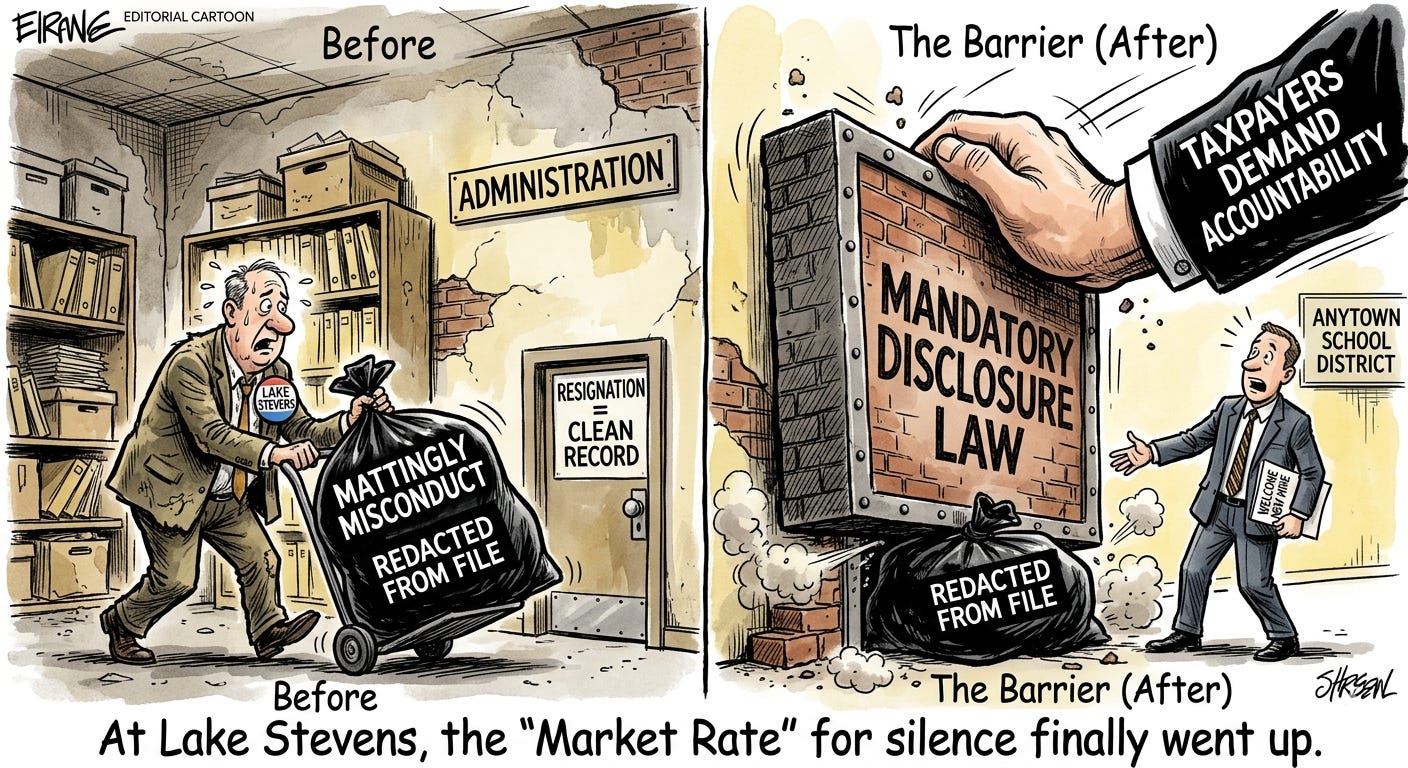
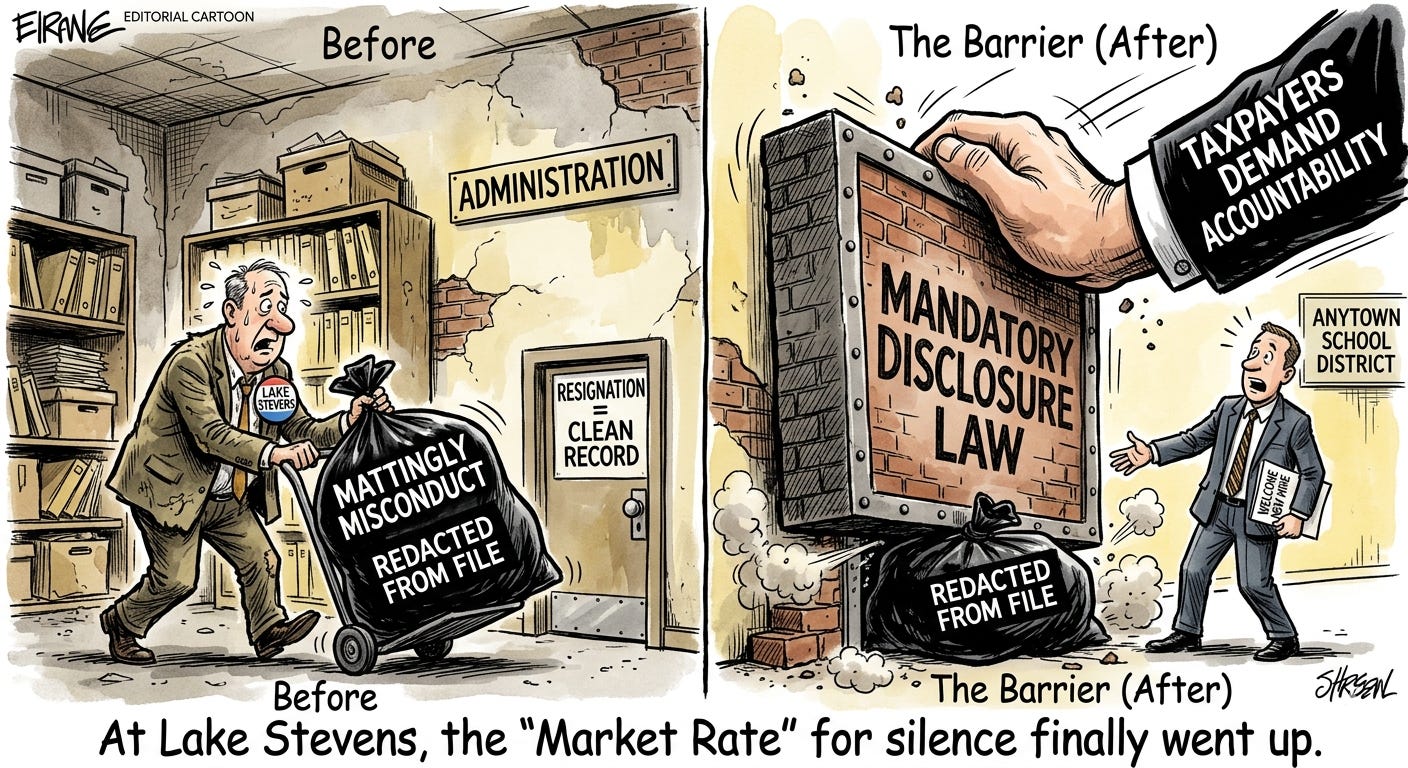
1. Overhaul Dismissal and Severance Policies A primary institutional failure in the Hein case was allowing the teacher to resign to avoid an internal investigation while receiving a $122,184 severance payout. To ensure this never happens again, LSSD should:
Prohibit confidentiality and severance agreements that allow an employee to resign or retire in exchange for financial benefits or the cleansing of their personnel file to eliminate references to misconduct.
Implement a strict ban on “passing the trash,” prohibiting the district from aiding any employee known to have engaged in sexual misconduct in obtaining a new job elsewhere.
2. Implement Rigorous, Standardized Hiring Screens Background checks and fingerprinting must be supplemented with proactive screening, as over 80% of identified child molesters in schools have no prior criminal records. LSSD should:
Require a standard screening tool where applicants must disclose if they have ever been the subject of an abuse investigation, been disciplined, or surrendered a license due to misconduct.
Mandate administrator contact with an applicant’s current and former school employers specifically to inquire about their behavior history.
Require written authorization from applicants releasing previous employers from liability for sharing detailed employment information.
3. Expand Training to All Employees and Students The district’s new training should not be limited to teachers. Comprehensive education must be:
Mandated for all employees, including superintendents, coaches, janitors, bus drivers, and volunteers, as adults are the first line of defense.
Mandated for all K-12 students using age-appropriate curricula that also covers child-on-child sexual abuse.
Required without a “parent opt-out” provision (except for known victims), as perpetrators of intra-familial abuse may attempt to shield children from training that could lead to a disclosure.
4. Establish and Teach a Strict Adult Code of Conduct Instead of treating severe red flags like grade-switching and inappropriate touching as mere “boundary invasions,” LSSD must implement a clear standard of behavior. The district should:
Adopt a comprehensive Code of Conduct for all staff and volunteers that explicitly describes appropriate adult/child interactions and identifies the boundary-violating behaviors that act as precursors to sexual offenses.
Teach students the Code of Conduct so they explicitly understand appropriate interactions and know to report any boundary violations immediately.
Engage parents by sharing this Code of Conduct on the district website and in student handbooks, making it clear that LSSD prioritizes protecting children.
5. Deploy Student Safety Posters District-Wide While LSHS students had to stage a massive walkout to protest a “climate of abuse,” the district can actively foster a culture of safety by placing Student Safety Posters in prominent locations. These posters should feature child abuse reporting hotline numbers and reinforce the message that students have a right to be safe, while reminding them that trusted adults are available to help.
Providing trusted channels of communication and instructing students how to access them can be a key that unlocks the gate blocking accountability.
As Shuldiner said, not knowing where to go effectively short circuits reporting before it occurs.
“One of the reasons why I think the district hasn’t done as good a job as it should around stuff like this is where would you go? Who are you going to talk to? Who are the people that you trust if something bad is happening?” he said.
“I’m not even sure as the superintendent that I know who I would call.”
If all goes to plan, maybe the superintendent of Seattle Public Schools will find he has an ally in accountability he can call at the Lake Stevens School District.
At the very least, an opportunity exists in Lake Stevens, combined with the prospect of an emerging leader in the states biggest district…for the first time in a long time…those engaged in the battle against predation of children in public education….may have reason for optimism.
J425 publisher Kevin Thomas Hulten is an accredited investigative reporter. His work on the Hein investigation was a 2024 LION National Journalistic Impact Award finalist.
Very long winded. Maybe necessary.
If the administration and teachers union were personally liable from their wages, maybe there would be a better response to a "maybe violation" of teacher/student relationships.